Braked vs unbraked towing weight
15 Aug 2026 · by Jérémy Vaucher
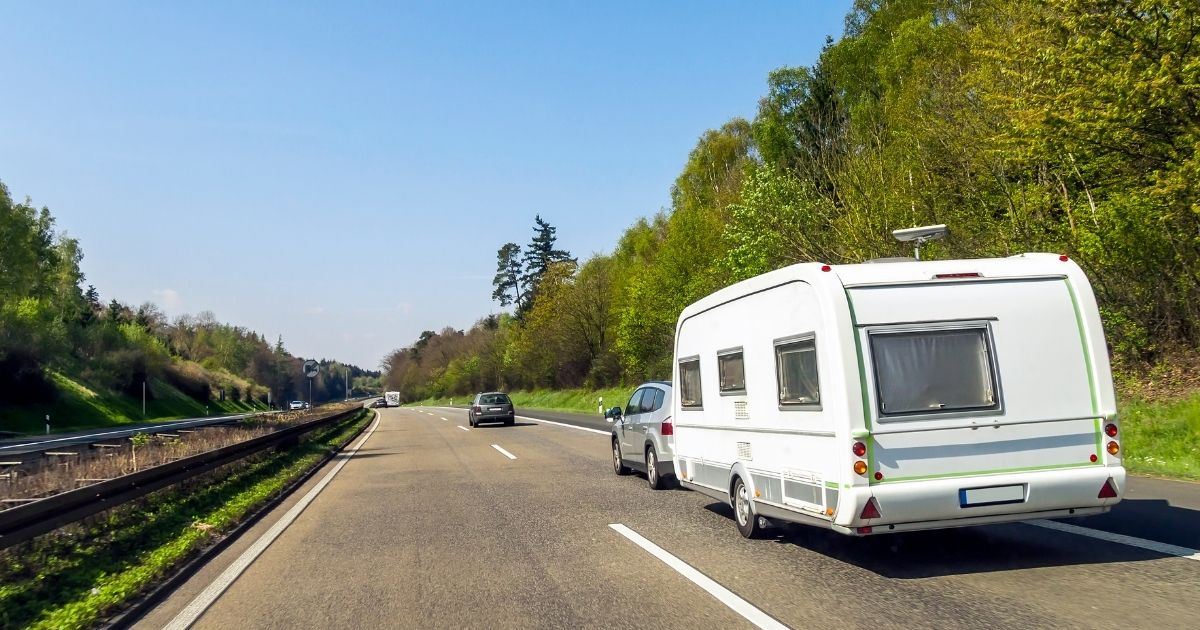
Towing is never summed up by a single figure on a spec sheet. There are always two: the braked towing weight and the unbraked towing weight. Mixing them up is the quickest way to buy a trailer your car is not allowed to pull, or to sell yourself short on capacity you already have.
The distinction is simple once it is laid out, and it changes the whole reasoning when you come to choose a caravan or a flatbed trailer.
Two figures, two situations
The difference is not about your car, it is about the trailer. A braked trailer has its own braking system, usually an overrun coupling: when the car slows, the drawbar compresses and applies the trailer brakes. An unbraked trailer has none of that, so the car brakes alone have to stop the whole outfit.
Manufacturers therefore publish two limits. The first applies when the trailer can brake itself, the second when it cannot. The unbraked figure is always far lower, for the obvious reason of stopping distance.
The unbraked towing weight
This is the limit for small trailers: luggage trailers, garden trailers, small flatbeds. It is capped by regulation and stays low, even on cars that are very capable elsewhere. A large SUV and a hatchback can quote the same unbraked figure while being worlds apart once braked.
That figure applies to the trailer loaded, not empty. A trailer described as light gets heavy quickly once filled with rubble, timber or house move boxes. What counts is the total, and the total should be weighed.
The braked towing weight
This is the number everyone looks at, and the one that decides whether your caravan works or not. It depends on the engine, the drivetrain and sometimes the gearbox: on one model, two versions can be several hundred kilos apart. That is why every page on this site lists the figure version by version rather than a misleading range maximum.
Take the Peugeot 3008, the Skoda Kodiaq or the Toyota RAV4: braked capacity is not the same across fuel types and drivetrains. Trusting the model name without checking the version gets it wrong roughly half the time.
Where to read these figures
Three reliable sources, in this order.
- The manufacturer plate, in the door shut or under the bonnet, which states the maximum permitted masses for your vehicle.
- The owner handbook and the official manufacturer technical data, which give braked and unbraked towing weights for each version.
- The V5C logbook, which records the weights for your exact vehicle. Where towable mass appears, it uses code O.1 for braked and O.2 for unbraked.
If a brochure and your own documents disagree, the documents for your actual vehicle win. Always.
The gross train weight trap
A high braked figure is not enough on its own. The outfit also has to stay under the gross train weight, meaning the loaded car plus the loaded trailer. That is why real towing capacity is the lower of two results: the braked towing weight on one side, the gross train weight minus the gross vehicle weight on the other.
The mechanics are set out in how to work out your towing capacity, and the two terms are compared in gross vehicle weight and gross train weight. Those two pieces are the groundwork before you commit to a caravan.
Braked or unbraked: which to choose
If your need is well beyond the unbraked limit, there is no debate: you need a braked trailer. For occasional light use, an unbraked trailer stays simpler, cheaper and easier to move around by hand.
Beware of one common assumption: that a braked trailer is always the more forgiving choice. It is on weight, but it demands real maintenance. A seized overrun coupling, worn shoes or a tired breakaway cable turn the theoretical advantage into a genuine hazard.
The method that avoids the mistake
- Weigh or seriously estimate the trailer loaded, not empty.
- Check whether it is braked or unbraked, then read the matching figure.
- Check the real towing capacity of your exact version on its page.
- Make sure the outfit stays under the gross train weight and that your licence covers the combination.
- Keep margin in hand: running at the legal maximum makes an outfit nervous and hills miserable.
To start from a list rather than a single model, the rankings by capacity are built for that: 1,000 kg, 1,500 kg or 2,000 kg. To separate two cars, the comparison tool puts them side by side, version by version.
The hire trailer case
Hiring a trailer for a house move is where mistakes cluster, because the driver knows neither the equipment nor its limits. Two minutes at the depot are enough to make the drive home safe.
Start with the manufacturer plate on the drawbar or the chassis: it states the maximum authorised mass of the trailer, which tells you immediately whether your car can legally pull it. Then check whether it brakes itself: a sliding drawbar with a damper means a braked trailer, a rigid A frame with no mechanism means the opposite. Finally ask for the unladen weight, because the payload quoted by the hire desk says nothing about the total once you have loaded it.
Two more points deserve attention. The hire company wiring is not always compatible with your socket, so sort an adapter before you leave rather than in a lay-by. And check your insurance: cover for a hired trailer is not automatic, and that conversation belongs before the trip, not after it.
Noseweight matters too
Respecting the towing weight is not enough if the load is badly balanced. The downward force the drawbar applies to the ball, the noseweight, has its own ceiling, set by the car, by the towbar and by the trailer. The lowest of the three applies.
A rear heavy trailer lightens that noseweight and turns twitchy the first time a lorry goes past. A front heavy one drops the back of the car and overloads the rear axle. Both are bad, and neither shows up on a spec sheet: they are measured, hitched up, before you leave.
In short
The unbraked figure covers small trailers with no brakes and stays low. The braked figure covers trailers with their own braking system and goes much higher, but varies sharply between engines. In both cases the paperwork for your own vehicle takes priority, and the gross train weight sets the final ceiling. Always check the V5C logbook before towing.